THIS IS ONE LANDSCAPE, DIVIDED
Billytown Gallery • The Hague / The Netherlands • 2023
Space Walk
Kim Junghyun, Art critic and an independent curator, based in Seoul and New York.
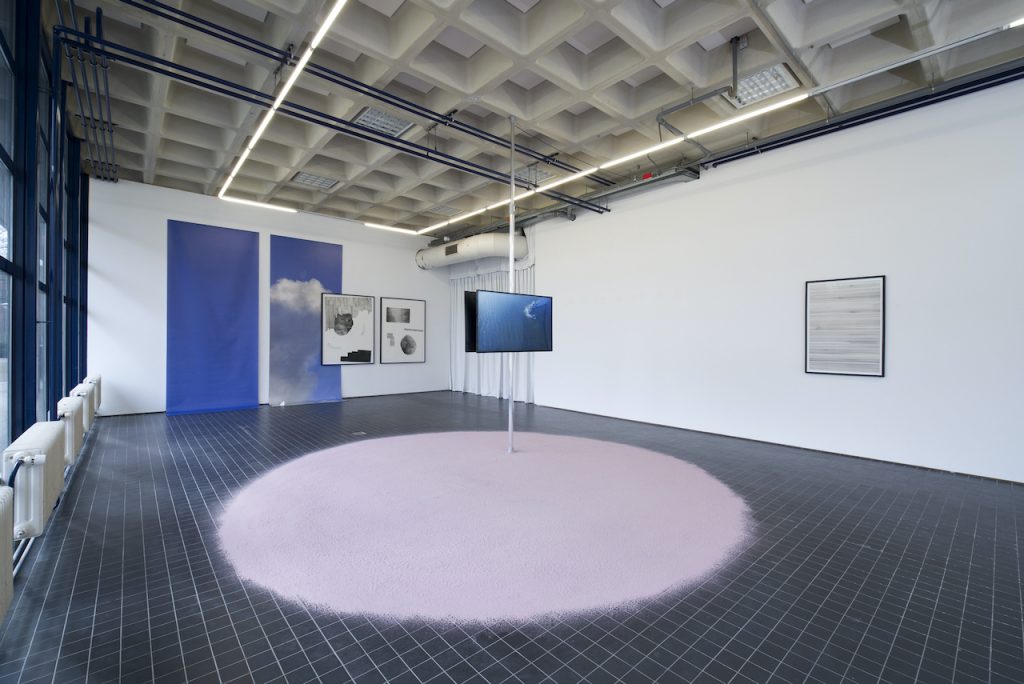
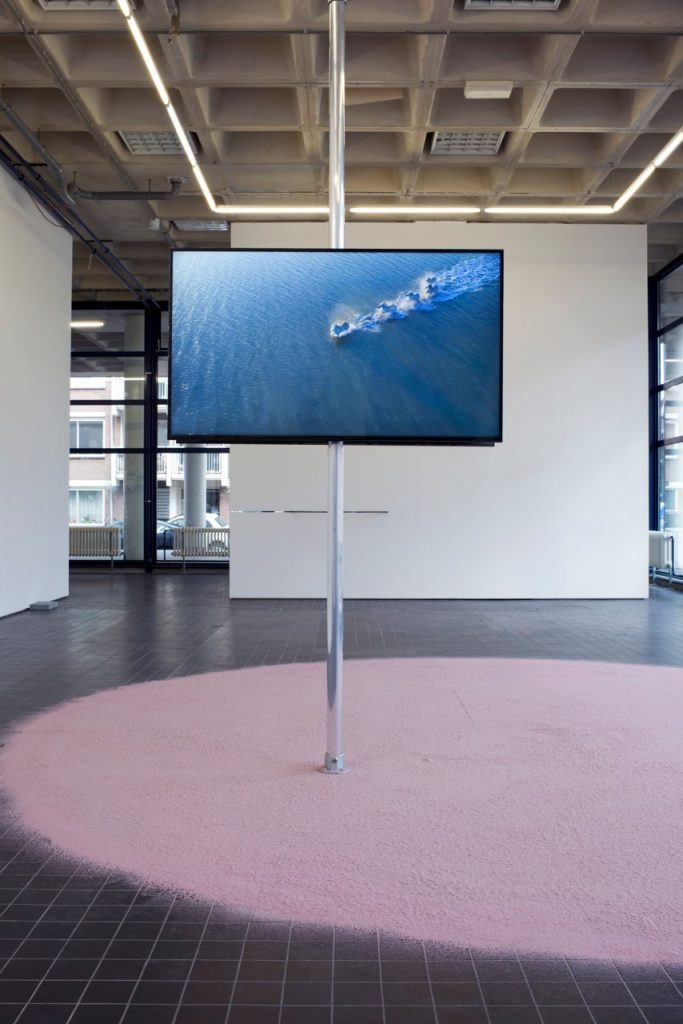
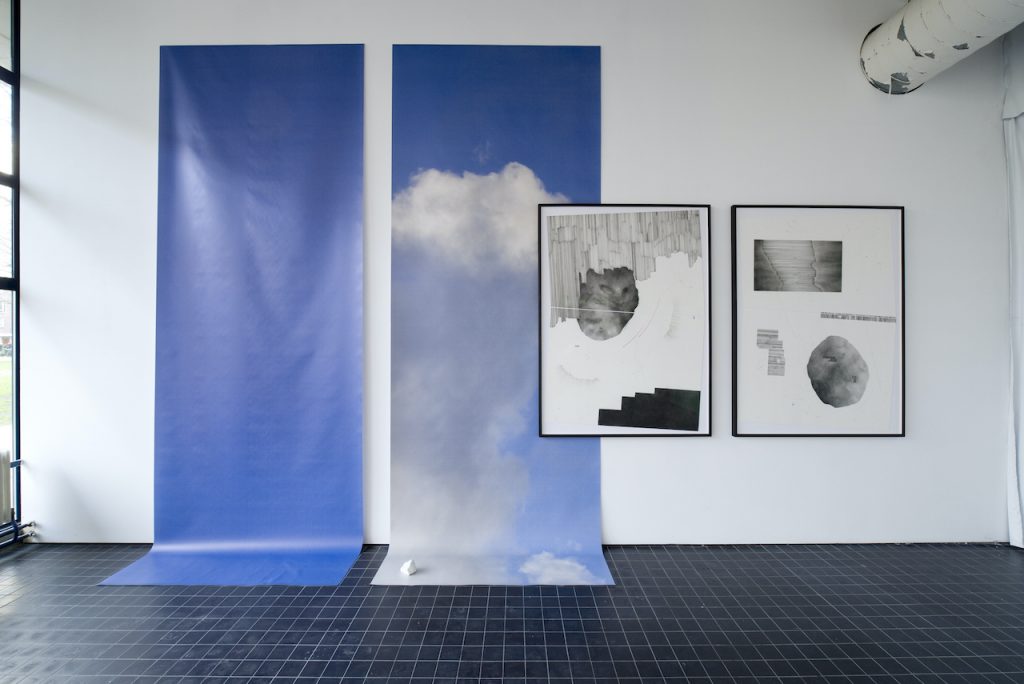
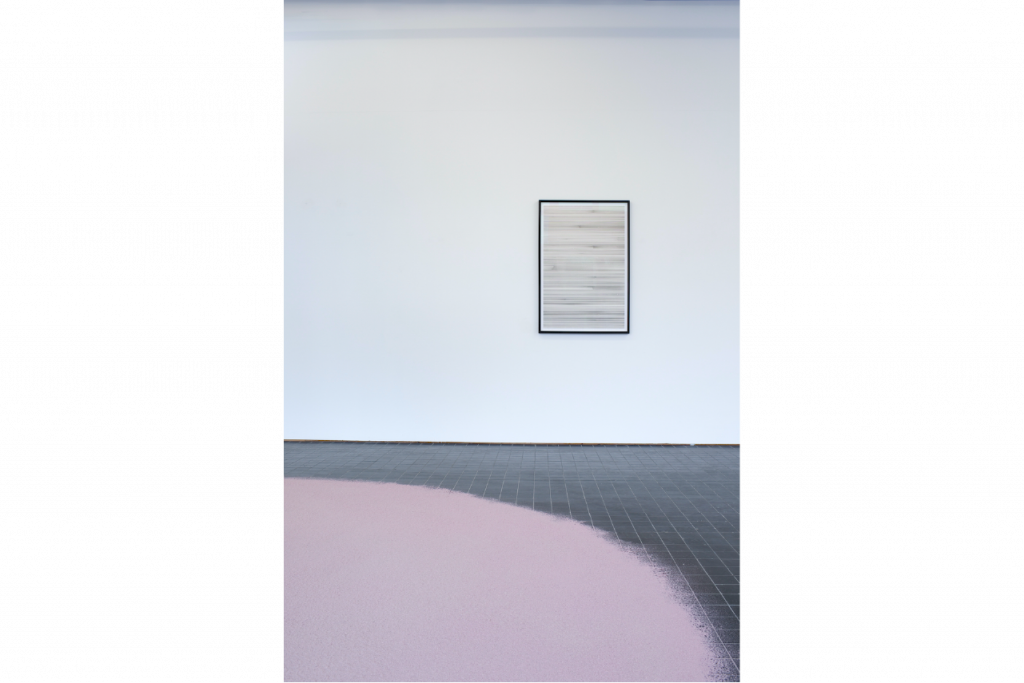
The visual image of everyday, anonymous place can be said to have emerged with the advent of photography. Recall the monumental nature of space occupied by traditional painting and sculpture. The camera proves that an object “is/was there” through machinery vision. Along with the camera, the modern invention of recording devices allows for a ‘ghostly’ encounter beyond the ‘phenomenological’ encounter of object and subject. The experience of objects that cannot be captured by the human senses has opened a vast world of fictional narratives through those younger modern media, from photography and film to VR and AI. Katherina Hail combines archival images with fictionalized drawings to create surreal landscapes. Blue Sky Thinking (2023), a photograph of a cloudy blue sky and a 3D printed small stone sculpture. Film footage of a herd of white horses running across the waterfront and a pink sandy floor in Placebo (2023).
Through a straightforward mode of representation the juxtaposition of recorded and artificially recreated nature – the artist consciously blurs the line between reality and fiction. More precisely, by emphasizing the former and contrasting the latter, she evokes a fictional sense of the hyper-real, beyond the reality of humanistic vision.
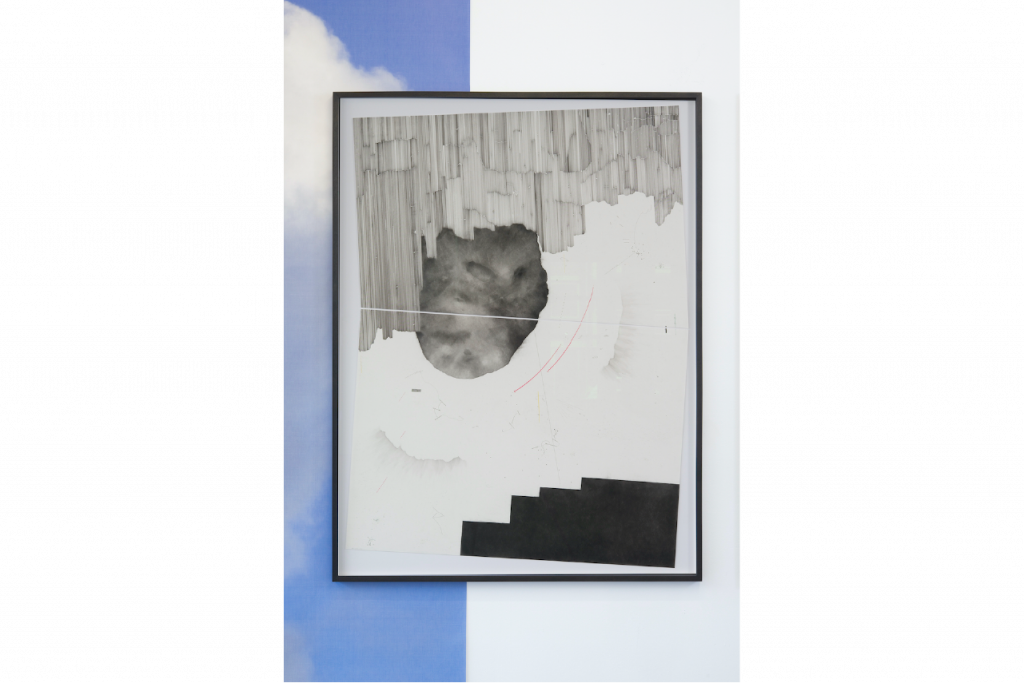
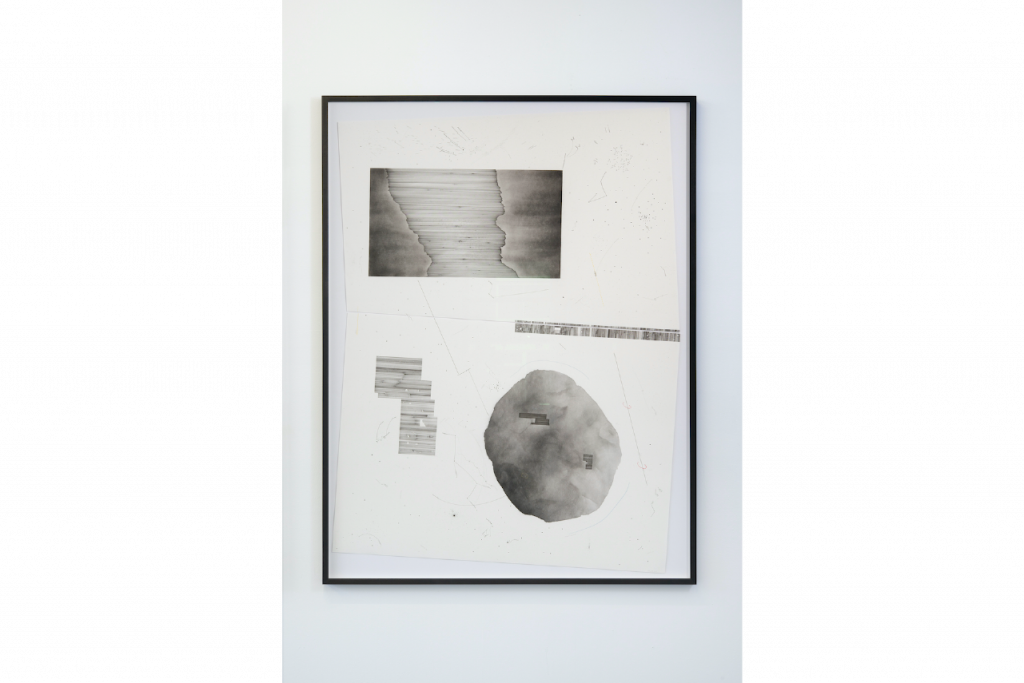
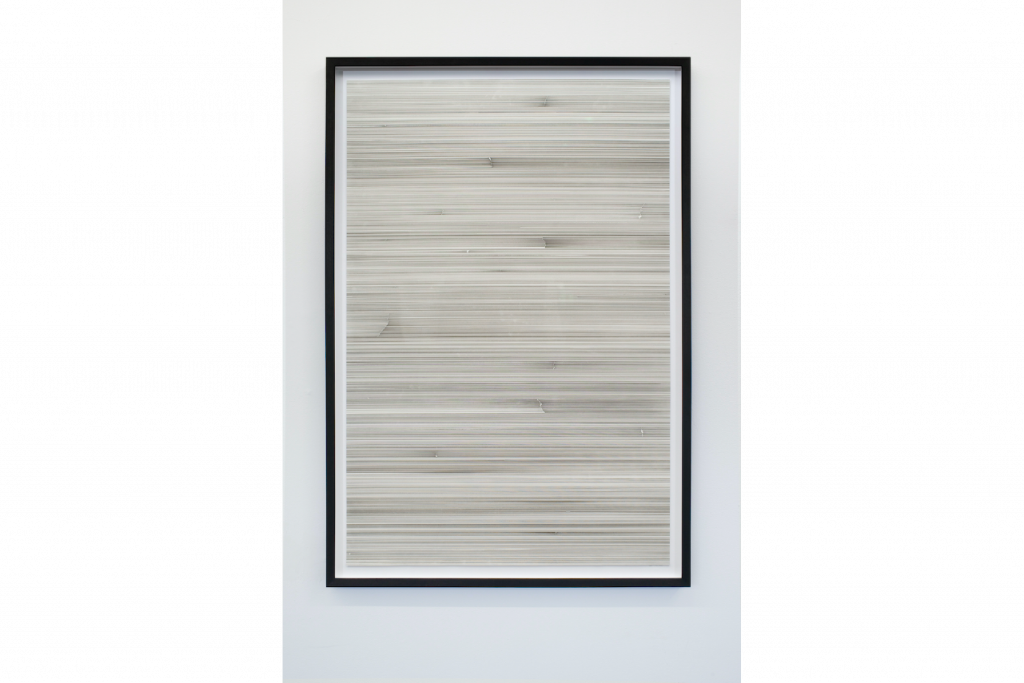
This dual strategy is also present in her drawings. In The Huge Amount of Matter Between Me and The Distant Light Source (2023) and Collecting Anomalies (2023), densely drawn horizontal lines are whitewashed out with short lines or small shapes, long-tailed arrows appear repeatedly in the margins, and scientific terms referring to celestial phenomena are handwritten. The artist’s main references are the photographs of the universe sent back by observational telescopes in space, and the language of astrophysics, the study of space and matter by analyzing them.
The clear pictures of colorful galaxies are astonishing, allowing us to detect light from places so distant and old that the human eye cannot capture them.
What is equally astonishing is how scientists can access the secrets of time and matter in galaxies. The James Webb Space Telescope uses transits to observe planets and provides clues to research by examining the changes in the brightness of the parent star over time as the planet passes through it. The artist borrows from the ghostly reality of archival photography produced by advanced scientific technology, and the graphics and conceptual language of spectroscopy, which is newly endowed with an unfamiliar visual reality, to create pseudo-scientific drawings.
“The language of space science can be understood in different ways: scientifically or emotionally. I want to understand it in my own way”.
According to the artist, when it comes to her work, it might be better to pay more attention to the desire for a fictional narrative triggered by the new images rather than focusing on the act of imitating science or its similarity. Her image-narratives are organized according to a spatial rather than temporal logic. Rather than the linear structure of written language, with sentences, paragraphs, the flow of story from introductions to conclusions, they are orientated towards a map that can be freely entered from any direction or Mallarme’s poetry of a temporal-spatial plane of geometry.
Katherina’s spatial reverie has been fueled by a favorite small stone she acquired by chance a few years ago. From the stone, which she keeps in her studio and looks at often, to the various images that replicate it, and now to the fictions of the universe that it materializes. Space observation photography seems to declare the extreme visibility of human reality, but paradoxically dictates the sensory limitations of the human body. What does this have to do with our earlier discussion of the various physical spaces of the visual arts?
The artist’s language, which epically connects the smallest matter with the vastest material world, is closer to Spatial fiction, which appropriates scientific language, than to science fiction, which employs the scientific imagination. The universe is the largest room in an everexpanding material world. Humans have barely taken the first step towards a walk in that big room, but the power of the machine eye and scientific theory allows us to plot a path for a virtual walk in our own small, familiar room.